
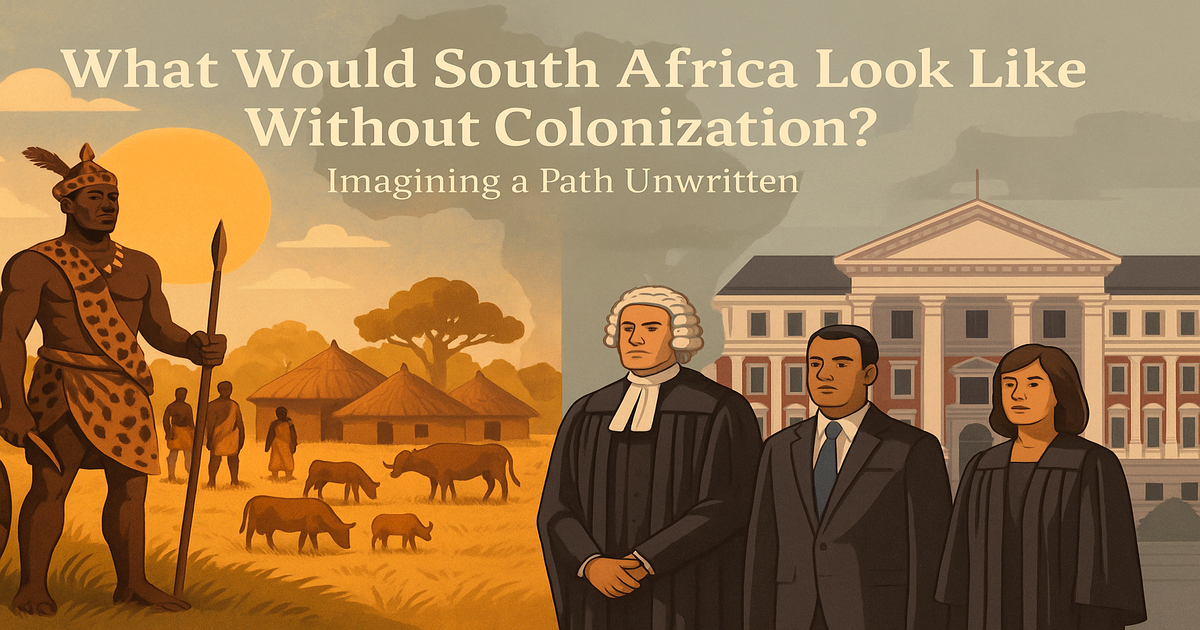
Colonization is the process of taking control of a foreign territory or region of people with political or military force – not the birthplace of a democracy. Imperial expansion comes with the cost of destroying indigenous and black populations for the commercial gain of inhabited land. European colonization weaponized religious expansion as a guise to increase wealth, influence, and agricultural trade.
Prior to colonization, African nations had already established complex societal structures with a military system of governance and a chiefdom as municipal administration. Expansion of the Zulu nation of Nguni-speaking people in KwaZulu-Natal province, South Africa were an organized community of farmers who herded cattle within clans. Clans would be comprised of familial patrilineal groups, each with rights to their own fields and herds typically under a patriarchy. The chief of each clan is the leader in war and municipal discourse. Headmen, underneath the chief, will provide oversight of different groups within the chiefdom. The Zulu army was comprised of different regiments, each led by a young, appointed royal under direct control by the king.
The sustainability of early South African governance was debated among academics for its inability to evade colonization and for its structural functions in pre-colonial political discourse. If not for imperialism, the development of present day South African governance would have looked vastly different in its procedures, constitution, and parliament. Current day South African governance is a constitutional democracy, where power is distributed across three tiers of government: national, provincial, and local. Like most western democracies, the parliament in South Africa is composed of a National Assembly and the National Council of Province, as the legislative body. The country has an independent judiciary system to ensure that fairness and an impartial system of justice regulates powers and procedures. Provincial legislature governs the country’s nine provinces whereas, local government acts in a similar manner to city/ township municipal administration in the west. South Africa is comprised of a multi-party system, allowing diverse political parties to express their interests, however, has two major parties, the African National Congress (ANC) and the Democratic Alliance (DA). Comparatively, there is not much difference between South Africa and the West – that is because colonization was successful in its invasion and overthrow of the Zulu Nation. It is easier to copy and paste on a blank sheet of paper than to backspace all its previous content – and that is the point of this article.
What if there was never any European contact? Would it be safe to assume that South African government officials wouldn’t have adopted British colonial bibs and gowns? In the late 18th century, British colonists met Bantu speaking chiefdoms near present day Cape Town. Since initial contact, the British wielded warfare eventually leading to succession of the isiXhosa speaking chiefdoms and later succession of Cape Town. During this time there was more than one Euro nation competing to bogard resources, the Dutch, British and the French. As Euro-nations competed to outbuy trading ports, the Zulu nation struggled to sustain themselves as other ethnic regional chiefdoms were established. Let’s assume Euro nations had left trading ports and had never compromised Cape Town, would it be far-fetched to assume that the isolated chiefdoms would unify to formalize as a recognizable government? Although difficult to imagine, it could be argued that the most possible clause for South African government development, without colonization, would be unification of its largest and strongest chiefdoms reinforcing internal trade, continued evolution of their social structures, and greater industrialization of its agricultural landscape. Maybe, the strongest chiefdoms would have industrialized the mining industry -exporting natural resources, gold, and diamonds for international export. There is no doubt that the technology utilized for agriculture would have sooner revolutionized the country to have entered a technocratic era sooner than its western imperialists. Of course, this is all hypothetical – the evolution of South African governance, with or without euro-colonization would have been a challenging journey with ethnic tribal conflict, genocide, and military upheaval. But it takes imagination to create a world absent from being oppressed first. If democracy wasn’t introduced, following the Apartheid, would South Africa have adopted a Republic structure of governance instead? Enforcing independent ownership of trading ports with an emphasis on regional autonomy. Allowing each province, with an overarching administration to regulate commerce, society, and entrance to the global community. Like its neighboring states, a republic government structure has provided foundation for retaining its societal customs, cultural norms, and national pride.